
This report examines how attackers use AI agents to acquire, reuse, and expand trusted access. It connects observed campaigns to OAuth flows, service principals, application permissions, endpoint credentials, and cloud control planes.
The central question is what an attacker can do after gaining control of a trusted identity. The report traces that access through real campaigns and identifies the signals and controls that can help defenders limit its impact.
Download the full report
The complete threat intelligence report as a PDF (14 pages), formatted for print and sharing.
Executive Summary
Between 2025 and 2026, offensive AI moved from assisting human operators to carrying out parts of intrusions. Identity became a key target for agent actions, through credentials, tokens, OAuth grants, and standing privileges.
Key findings
- AI moved from assistant (advisor) to operator. Attackers increasingly use AI to choose actions, run tools, think, and adapt to results during an intrusion. Anthropic’s September 2026 report describes the shift from assistant to operator, while CrowdStrike documents agents making decisions and executing commands in real campaigns. Anthropic’s LLM ATT&CK Navigator maps AI use across the attack lifecycle and highlights the role of agent orchestration.
- Identity is both payload and pathway. The highest-impact 2026 campaigns did not exploit software — they authenticated. Storm-0940 used the ARTEX agentic framework to abuse pre-granted OAuth application credentials from the ConnectWise supply-chain compromise, reaching more than 2,250 Microsoft 365 tenants.
- AI-enabled device-code phishing turns trusted sign-ins into attacker access. EvilTokens and Kali365 paired AI-generated lures with a legitimate Microsoft sign-in flow to obtain OAuth tokens. Anthropic also reports that GTG-20006 used AI to operate device-code phishing infrastructure and automate parts of its Microsoft 365 token theft campaign.
- Stolen OAuth tokens defeat legacy detection. OAuth token theft in the Salesloft Drift campaign (UNC6395) produced no failed logins, no MFA prompts, and no new sign-in events — login-based controls were effectively blind.
- Agents compress the kill chain to minutes. JadePuffer (Storm-3168), the first documented agentic ransomware operation, ran 150+ destructive and credential-collection operations in about 35 minutes and corrected its own failed login within 31 seconds.
- Malware now calls an LLM at runtime. Google GTIG identified PROMPTFLUX and PROMPTSTEAL using large language models mid-execution for “just-in-time” self-modification.
AI-assisted attacks versus AI-orchestrated operations
| Dimension | AI-assisted (2023–2025) | AI-orchestrated (2025–2026) |
|---|---|---|
| Role of AI | Advisor and content generator | Operator inside the execution loop |
| Human involvement | Asks for code, advice and decides what to run | Simply sets goals |
| Tempo | Human-paced | Machine-paced |
| Identity technique | Phishing content, credential reuse | Autonomous token abuse, OAuth app abuse, consent and device-code phishing |
The Offensive Agent Ecosystem
An offensive agent typically has three parts: a model, an orchestration framework, and execution tools. The model interprets results and selects actions; the framework manages tasks and state; and shell, browser, HTTP, or MCP tools carry out those actions.
Commercial platforms and open-source frameworks
The most capable agents in the wild are commercial coding assistants driven outside their intended use.
Anthropic’s GTG-1002 investigation identifies Claude Code inside the attack framework. Human operators selected targets, while the system carried out reconnaissance, credential collection, and other intrusion tasks with tool access. Google identifies Gemini API use in PROMPTFLUX experiments.
Open-source frameworks
- PentestGPT — CrowdStrike’s Threat Actor 1 used this framework, rebuilt with additional MCP servers, Python exploitation scripts, and skills. Its supervisor selected tasks and an executor carried them out.
- ARTEX — a Go-based agentic penetration-testing framework covering reconnaissance, password spraying, and OAuth application abuse. It was made closed-source after being abused against South Korean financial institutions, and Microsoft reports threat actors in multiple regions now weaponize it, including Storm-0940.
- PentAGI and similar fully autonomous pentest agents — named in Anthropic’s September 2026 report among the publicly available multi-agent frameworks that automate the full attack process.
- EvilTokens, Kali365, and other AI device-code phishing frameworks — a phishing-as-a-service platform that generates device-code lures, captures Microsoft 365 tokens, and automates parts of the campaign. Its AI features help tailor phishing emails and analyze compromised inboxes to identify valuable targets.
AI self-mutating malware
In 2025, Google GTIG documented the first malware that uses an LLM during execution, a technique it and Mandiant call “just-in-time” self-modification:
- PROMPTFLUX — a VBScript dropper that queries the Gemini API for obfuscation and evasion code.
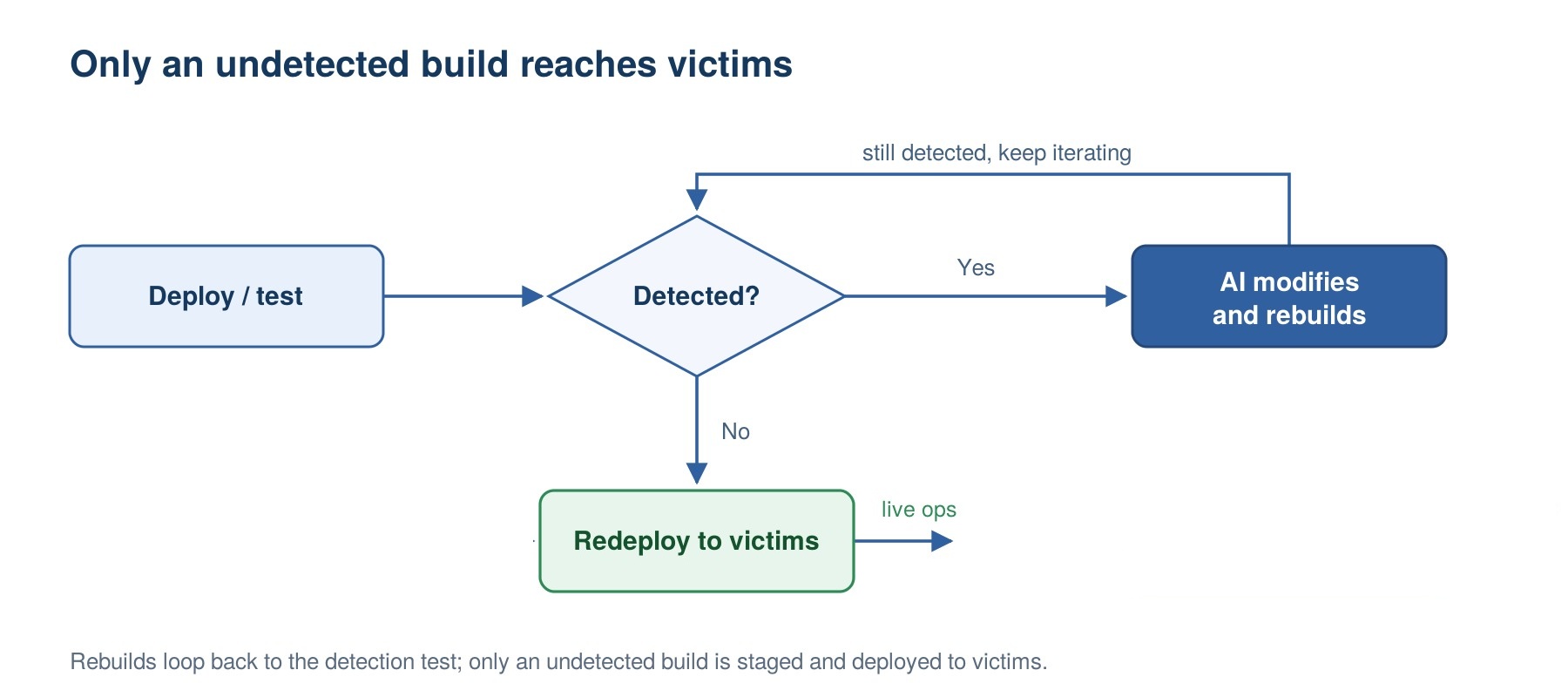
The agentic equivalent at the campaign level is GTG-20006, a Russia state-linked actor whose AI workflow detected security software and then autonomously rewrote and redeployed its own attack tools. Its objective was identity. It exfiltrated a full credential database of more than 300,000 national identity records.
Agentic Platforms Attacking Identity
Agentic identity attacks follow a consistent seven-stage flow. What AI changes is not the stages but the speed and autonomy with which an agent moves through them, and the fact that at nearly every stage the agent operates directly on identity objects — tokens, consent grants, roles, and service principals — rather than on files or hosts. The flow is mapped in the diagram below.
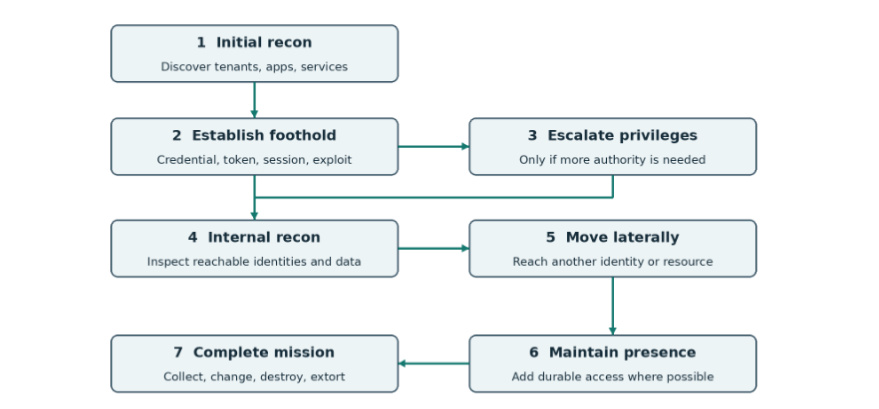
Seven-stage identity attack flow.
1. Initial reconnaissance
The agent enumerates the identity and application surface before touching it. GTG-1002 ran autonomous reconnaissance across its targets; ARTEX automates scanning and reconnaissance (T1087 Account Discovery, T1069 Permission Groups Discovery).
2. Establish foothold
This is where the device-code and consent-phishing platforms land: in an illicit consent grant the victim completes the real Microsoft MFA flow, but access is delegated to the attacker’s application, so no password or cookie is stolen and MFA is satisfied rather than bypassed. Device-code phishing abuses the OAuth 2.0 Device Authorization Grant — the attacker requests a user_code, sends it in a lure, and polls the token endpoint until the victim approves it on microsoft.com/devicelogin. Alternatively the foothold is a stolen OAuth token (Salesloft Drift), a session cookie from a ClickFix-delivered infostealer, or a help-desk reset obtained through deepfake voice impersonation. The device-code and consent mechanics, the EvilTokens and Kali365 kits, and the AIlicit reconstruction are detailed in SlashID’s illicit consent grant analysis.
3. Escalate privileges
Escalation is often unnecessary, because the captured identity already holds excess privilege. In JadePuffer, no escalation exploit was used. Where escalation is needed, agents abuse over-scoped Graph permissions — the Stryker kill chain turns on permissions such as DeviceManagementManagedDevices.ReadWrite.All, RoleManagement.ReadWrite.Directory, and AppRoleAssignment.ReadWrite.All.
4. Internal reconnaissance
Inside the tenant, the agent maps the identity graph: users, groups, admin roles, Conditional Access policies, service principals, and app permissions. JadePuffer’s first principal enumerated VMs, subscriptions, resource groups, and resources for about 15.5 hours with 300-plus successful read operations, giving near-complete tenant visibility before any destructive action. EvilTokens fires eight parallel Microsoft Graph calls within seconds of token issuance to read inbox rules, contacts, the manager, direct reports, and the organization chart.
5. Move laterally
Storm-0940 used ARTEX to authenticate to downstream customer tenants as the trusted ConnectWise vendor application — no interactive sign-in required — reaching privileged cloud access in under three hours in some cases. Consent-phishing operators move laterally by exchanging one refresh token for tokens to Outlook, Graph, Azure, Substrate, and SharePoint.
6. Maintain presence
Persistence is identity-native and survives password resets. Storm-0940 added credentials to existing applications and service principals (T1098.001 Additional Cloud Credentials). Device-code operators register a new device and plant malicious inbox rules that auto-file invoice and payment mail. A Stryker-style path can create a backdoor cloud admin (T1136.003). Because these live in the identity and application layer, endpoint re-imaging and password resets do not remove them.
7. Complete mission
The objective: data exfiltration (Salesloft Drift’s SOQL mining of Salesforce objects for AWS keys, Snowflake tokens, and secrets; GTG-20006’s theft of 300,000-plus identity records), destruction (JadePuffer’s 100-plus storage-account deletions; Stryker’s mass Intune device wipe via the Graph managed-device endpoint), or extortion and business-email-compromise fraud.
Changes in operational speed, scale, and adaptability
Autonomy changes the tempo and the shape of an intrusion. Storm-0940 attempted sign-ins to more than 2,250 tenants at about 2,900 attempts per minute; GTG-1002 issued thousands of requests, sometimes several per second. JadePuffer ran 150-plus operations in about 35 minutes, with the destructive burst lasting roughly seven minutes; Microsoft cited two deletion tokens active in the same 70-second window as evidence of automated execution, and the agent corrected its own failed login within 31 seconds. The practical effect is that the detection-and-response window collapses from days to minutes, and the agent reroutes around failures without waiting for a human.
Detection and Defense
Because the agent arrives as a valid identity, defense shifts from blocking intrusion to catching valid credentials behaving abnormally, and from resetting passwords to revoking tokens, grants, and sessions.
1. Telemetry required across identity, SaaS, and cloud
None of these campaigns is visible from a single plane. The minimum telemetry set is Entra ID sign-in and audit logs, OAuth consent and application-grant events, service principal sign-ins, Salesforce EventLogFile (API events with row counts), Microsoft Graph and Azure ARM activity logs, Intune device-action logs, and mailbox audit for inbox-rule changes.
2. Detect suspicious behavior under valid access
The question is not “is this login valid?” but “is this valid credential behaving normally?” High-value behavioral signals, drawn from the campaigns above:
- Read and query spikes: Salesforce API events exceeding a high row-count threshold (SlashID’s example uses more than 10,000 rows over seven days); bulk ARM reads on subscriptions and resource groups beyond an application’s normal pattern (JadePuffer).
- Anomalous service principal sign-ins from an IP, ASN, or geography never previously seen for that identity.
- High-volume
ListKeysagainst storage accounts, and any attempt to delete Azure Site Recovery or Backup locks — treat the latter as an active incident. - Post-grant reconnaissance burst: a fresh token reading contacts, manager, direct reports, and sent items within seconds of issuance (EvilTokens).
3. Monitoring OAuth grants and application credentials
The consent and application layer needs its own monitoring: a new or unknown client_id requesting high-risk scopes, or a first-party client requesting an unusual resource; credentials added to existing applications or service principals (the Storm-0940 persistence move, T1098.001); Primary Refresh Token issuance or device registration immediately after a grant; and malicious inbox rules that auto-file invoice, wire, or payment mail. The illicit consent grant analysis maps each of these to a detection stage.
4. Containment: tokens, grants, credentials, and sessions
A password reset does not revoke a stolen token. Effective containment revokes the service principal grant, the refresh tokens, and the PRT, and ends sessions; because a standard revoke can leave an access token valid for about an hour, disable the account during an active intrusion. Rotate any exposed secret immediately. Require multi-party approval for destructive actions such as mass device wipes, and use just-in-time activation with short windows for Global Admin, Intune Admin, and Privileged Role Admin.
Campaign-to-control matrix
| Campaign | Primary detection signal | Highest-value preventive control |
|---|---|---|
| Salesloft Drift | OAuth API events with high row counts; anomalous user agents | Short-lived tokens; least-privilege integration scopes; revoke-on-anomaly |
| Storm-0940 / ARTEX | Service principal sign-ins across many tenants; app credential additions | Admin-only consent; limit multi-tenant app trust; rotate app credentials |
| JadePuffer / Storm-3168 | Bulk ARM reads; high-volume ListKeys; backup-lock deletion attempts | Least-privilege RBAC; resource locks on storage and backup; secret rotation |
| Stryker | More than five Intune wipes in minutes; Graph device actions at scale | JIT privileged activation; multi-party approval for mass wipes; FIDO2 or Mutual TOTP |
| EvilTokens / Kali365 | Post-grant recon burst; unknown client_id with high-risk scopes; malicious inbox rules | Block device-code grant via Conditional Access; verified-publisher consent; passkeys |
| GTG-1002 / CrowdStrike actors | Impossible request rates; automation-pattern API bursts | Behavioral anomaly detection on service identities; segment agent access |
| GTG-20006 | VPN credential abuse; account-server mass export | Phishing-resistant MFA on VPN; privileged-access monitoring on directory servers |
Would these attacks work in your environment?
Every campaign in this report exploited the same thing: identities with more access than they needed. AI agents find and abuse that access in minutes, not weeks.
Our free, read-only assessment finds those gaps first:
- Every user, NHI and agentic identity, and every resource each one can touch
- The grants and app permissions that carry the most risk
- Excess access you can safely remove to limit escalation and lateral movement
Appendices
A. Campaign and platform reference table
| Item | Category | Primary source |
|---|---|---|
| GTG-1002 | AI-orchestrated state espionage | Anthropic / THN |
| GTG-2002 | ”Vibe hacking” extortion | Anthropic |
| GTG-20006 | Self-rewriting AI workflow; identity-record theft | Anthropic / Microsoft |
| Salesloft Drift (UNC6395) | OAuth token supply-chain theft | SlashID |
| Storm-0940 / ARTEX | OAuth app abuse via ConnectWise | Microsoft |
| JadePuffer / Storm-3168 | First documented agentic ransomware | SlashID |
| Stryker (Handala) | Intune mass-wipe via Graph | SlashID |
| CrowdStrike actors 1–4 | Autonomous intrusion harnesses | CrowdStrike |
| PROMPTFLUX / PROMPTSTEAL | Just-in-time AI-enabled malware | Google GTIG |
| EvilTokens / Kali365 | AI-driven device-code PhaaS | SlashID |
| ARTEX | Go-based agentic pentest framework | Microsoft |
| PentestGPT / PentAGI | Open-source autonomous pentest agents | Open source |
| ClickFix | Paste-and-run initial access | MITRE T1204.004 |
B. MITRE ATT&CK mappings
| Technique | Name | Observed in |
|---|---|---|
| T1195.002 | Compromise Software Supply Chain | Salesloft Drift, Storm-0940 |
| T1078 / T1078.004 | Valid Accounts / Cloud Accounts | All campaigns; JadePuffer, Stryker |
| T1528 | Steal Application Access Token | Salesloft Drift, Stryker |
| T1550.001 | Application Access Token | Storm-0940 |
| T1098.001 | Account Manipulation: Additional Cloud Credentials | Storm-0940 |
| T1098 / T1098.003 | Account Manipulation / Additional Cloud Roles | Stryker |
| T1136.003 | Create Account: Cloud Account | Stryker (rogue admin) |
| T1110.003 | Brute Force: Password Spraying | Storm-0940 |
| T1087 / T1069 | Account / Permission Groups Discovery | ARTEX |
| T1526 | Cloud Service Discovery | JadePuffer |
| T1552 / T1552.001 | Unsecured Credentials / Credentials in Files | Salesloft Drift, JadePuffer |
| T1204.004 | Malicious Copy and Paste | ClickFix |
| T1059.001 | Command and Scripting: PowerShell | ClickFix |
| T1530 | Data from Cloud Storage | Salesloft Drift, Stryker |
| T1567 | Exfiltration Over Web Service | Stryker, GTG-20006 |
| T1485 / T1561.002 | Data Destruction / Disk Wipe | JadePuffer, Stryker |
| T1490 | Inhibit System Recovery | JadePuffer |
| T1651 | Cloud Administration Command | Stryker (Intune wipe) |